
Experiences of Japanese Americans under the AEA
Hikoshichi Higuchi — What Could Have Been
What if everything had gone differently?
Tak Higuchi had wondered about that very thing: What if his father’s incarceration never happened? What if his own incarceration never happened? What if Tak himself had the chance to go to the school that he dreamed of?
Instead, this dream was stolen the moment that the FBI came to interrogate his father. The very same thing happened to the dreams of every other Japanese American who was incarcerated.
Hikoshichi Higuchi, Tak’s father, was 62 and a gardener who lived fully in his culture, as anybody might hope to do. Yet, just because that culture was Japanese, the government altered the trajectory of both his and his family’s lives.
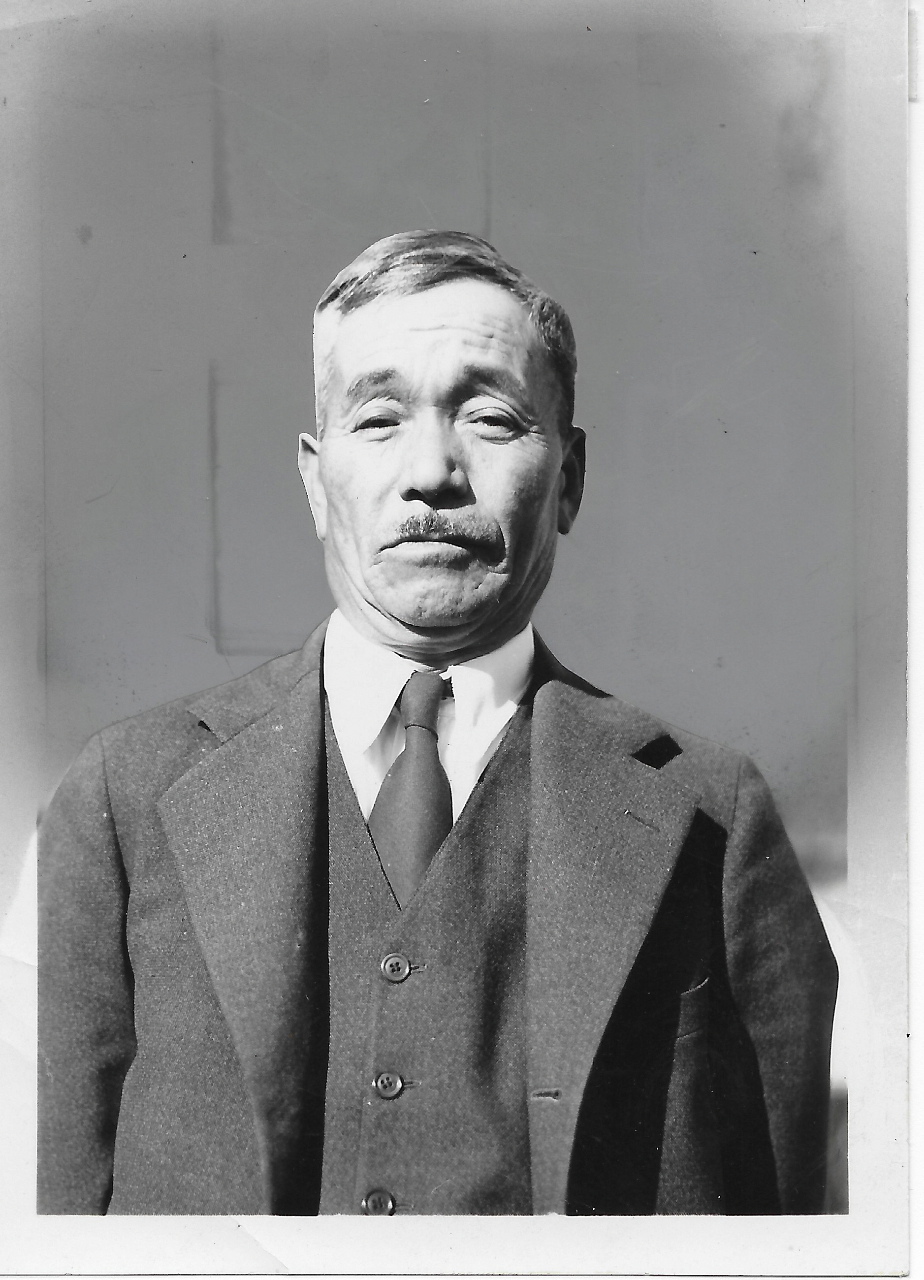
Photo of Hikoshichi Higuchi. Courtesy of Judy Higuchi.
Hikoshichi Higuchi, born in Fukuoka-ken on December 13, 1880, immigrated to the United States in 1904, seeking a better life that drew many Japanese immigrants away from the depression in Japan. He first worked as a houseworker in San Francisco until 1917, returning to Japan in 1912 to marry Haruyo Ichigi before coming back to the United States in 1914. Two of his four of his children were born in San Francisco.
After his job as a houseworker, he moved to Monterey, California, where he fished for four years. He later worked as a gardener for private families and businesses and eventually started his own gardening business. The last two of his children were born in Monterey, including Tak.
Hikoshichi was not as deeply involved with the Monterey Japanese community as some of those around him, though he was still an active force in the Buddhist church. FBI reports also indicate that he had once been a member of two other Japanese organizations in Monterey, though not at the time of his arrest. Given those associations, and the fact that Japanese was his native language, it is not surprising that the government viewed his culture as a threat.
After President Franklin D. Roosevelt issued Proclamation 2525 on December 7, 1941, many Japanese community leaders became targets under the Alien Enemies Act of 1798, treated as potential spies and possible dangers to the public. Through that proclamation, the U.S. made clear that people like Hikoshichi himself were now considered “enemy aliens.”
Yet Hikoshichi’s case was unusual. Unlike many of his “alien friends,” the FBI did not arrest him immediately in Monterey. Instead, he was interrogated and left behind after others were taken from their families. Still, he knew the FBI was watching him. Shortly afterward, his family moved to San Jose on February 20, 1942, one day after Executive Order 9066, seeking one of the few remaining “free zones” for the Japanese Americans.
Family Denied
Once again, the FBI interrogated Hikoshichi, this time in San Jose. Operating under the belief that Japanese immigrants were sending contraband and money to Japan, agents searched his home with his permission and found nothing. Even so, they arrested him and took him from his family.
Unbeknownst to his family, Hikoshichi was then sent on a long journey to various internment camps. He was sent to San Francisco in March of 1942, then to Sharp Park in March of 1942, followed by Fort McDowell (Angel Island) and Lordsburg in August of 1942, and finally to the Santa Fe Internment Camp in June of 1943. After his arrest, a local Alien Enemy Hearing Board determined in June 1942 that he was a “potentially dangerous alien enemy” and recommended “permanent internment.” The Office of the Attorney General upheld the decision, even though a memo about the hearing board’s findings noted that “the case is not free from doubt.”
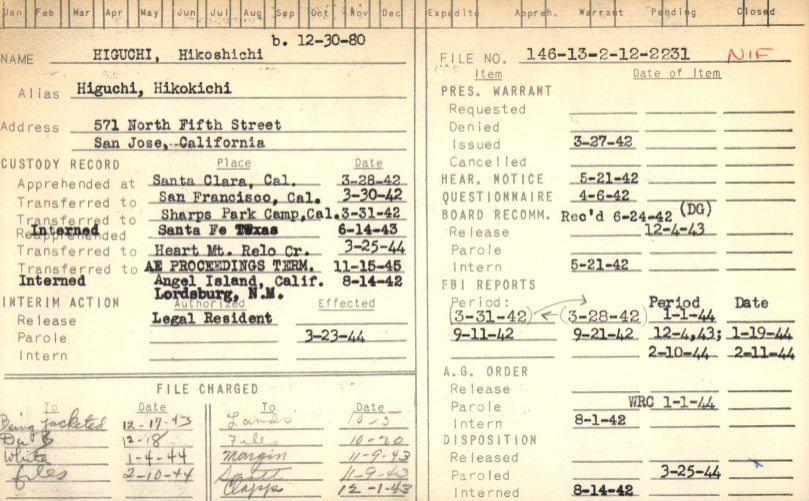
Hikoshichi Higuchi's internee card accessed through the National Archives.
Angel Island
Hikoshichi was one of only about 100 Japanese immigrants from the West Coast whom the government forced into Fort McDowell. Many of those who went to Angel Island were humiliated, stripped bare to be inspected, and confined to cramped barracks, with little-to-no walking space between each bunk.
The Department of Justice never found Hikoshichi — or others detained with him — guilty of espionage.
Rehearings
In March 1943, the Lordsburg Internment Camp administration described him as cooperative and noted that the company he kept was favorable. So four months later, Hikoshichi requested a rehearing in hope of a parole and reunion with his family. Around the same time, his son-in law, Kazuo Oka, wrote a letter to also request a rehearing. He told the Department of Justice that Haruyo Higuchi had been left alone; that Hikoshichi had been law-abiding; and that he hoped to maintain his residence in the United States with his family, all of whom were loyal to the country. In August, he was denied. Officials responded that his internment was “well founded,” that there was “no additional evidence has been presented in support of his application,” and that it was “improbable upon a rehearing [that] the order would be vacated or modified.”
Hikoshichi was later granted a rehearing through the Family Camp Applicant process in the late fall of 1943 at the Santa Fe Internment Camp. In December 1943, the Alien Enemy Special Hearing Board of the Department of Justice described Hikoshichi’s record at Santa Fe Internment Camp to be “barely fair,” and recommended he should be released. They concluded that he posed “no risk to the internal security” of the United States. He was released from the Department of Justice camp, but still was sent to a War Relocation Authority camp, remaining incarcerated.
In late March 1944 — eight months after he initially requested a rehearing — Hikoshichi was finally reunited with his wife at the Heart Mountain incarceration center in Wyoming. They were released in October 1945, three years and seven months after the FBI first arrested him.
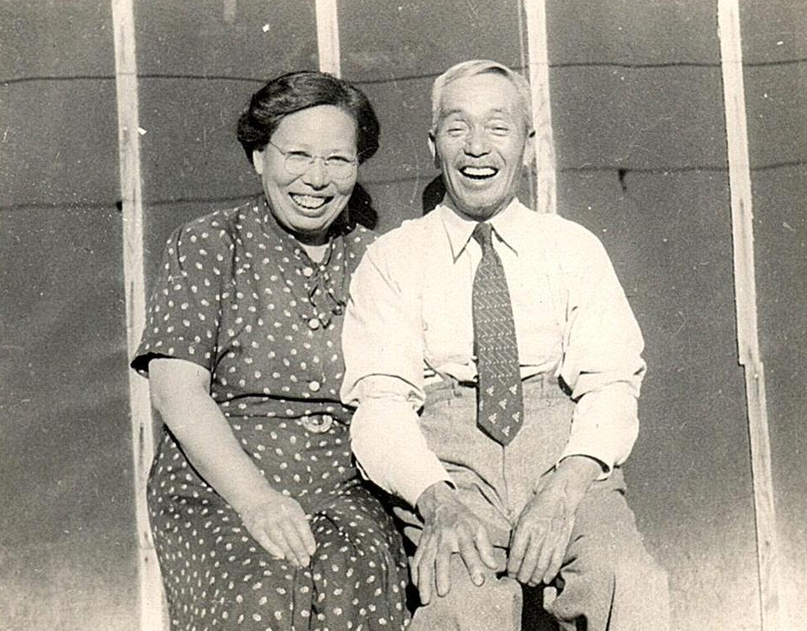
Haruyo and Hikoshichi Higuchi. Courtesy of Judy Higuchi.
After the War
Like many Japanese Americans who experienced the incarceration, Tak spoke little about his experiences, and almost nothing about his father’s detention under the Alien Enemies Act. Still, the trauma of separations, humiliation, and being ripped from their home and each other left a lasting impact on his life. Tak believed that his mother’s strokes and high blood pressure, as well as his father’s fatal heart attack, were caused by the “undue stress” of the forced removal and incarceration.
Had things gone differently, Tak might never have carried the pain, the feelings of inferiority, depression, and anger that followed the war. His parents might not have suffered the same illnesses, and they might not have died when they did.
However, things did not happen differently. In spite of this, Tak went on to achieve his dream of attending university — even if it was not at the time or place he had originally hoped. He was successful and enjoyed his life with his wife and two daughters, surrounded by family and friends.
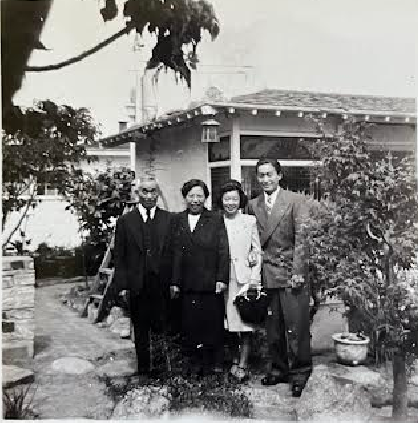
Hikoshichi, Haruyo, Mae, and Tak Higuchi. Courtesy of Judy Higuchi.
But things can happen differently now. The Alien Enemies Act is once again being used to unjustly incarcerate immigrants and disrupt families, and it is imperative that this law be repealed. No one should have to wonder what dreams they may have realized had the act never been used.
Written by: Kiyone Tanaka-Gacayan, based on original documents from Tak Higuchi, Hikoshichi Higuchi’s case file, and interviews with Judy Higuchi, granddaughter of Hikoshichi Higuchi
References
Taken From Their Families Exhibit from the Angel Island Immigration Station Foundation
Fort McDowell / Angel Island Densho Article (Densho)
Want to hear about more experiences of others under the AEA? Click a name below to learn more.