
Experiences of Japanese Americans under the AEA
Buntaro (Bob) Mayeda
Buntaro (Bob) Mayeda (1907–1989) was a middle-aged agricultural broker living in Yakima, Washington, when he was detained under the Alien Enemies Act (“AEA”) in January 1942. Having immigrated to the United States to achieve the American dream of owning land and getting rich, Buntaro built a successful produce brokerage business and became one of only three agricultural brokers in the Yakima area. He owned four produce trucks and established himself as a respected member of the local farming community. He soon became a community leader without really knowing it. Because he was ineligible for U.S. citizenship under the racial restrictions then in effect, property was held in the name of his wife, Toshi, who was raising their young children.
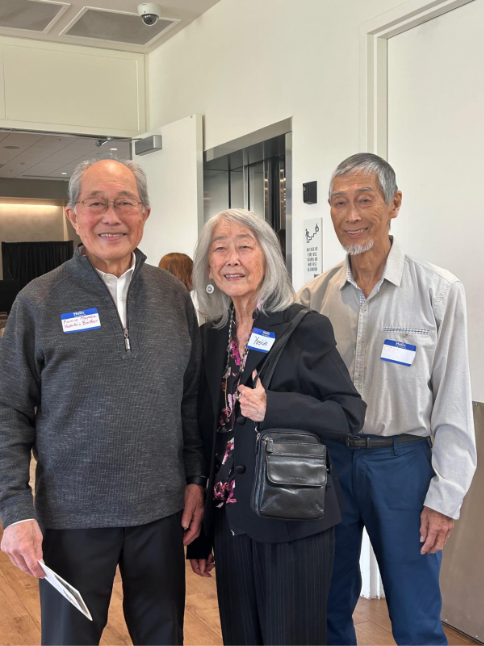
Three of Buntaro’s children (Pictured from left to right):
Fumio Mayeda (Son), Yoshiko Uno (Daughter), Teruo Mayeda (Son)
In January 1942, federal authorities took Buntaro pursuant to the Alien Enemies Act. FBI agents removed him from his home without meaningful notice or due process, separating him from his wife and two children. Toshi was pregnant at the time with twins. He was first detained at the Yakima County Jail, where he remained until October 1943. He was then transferred to the Department of Justice internment camp at Fort Missoula, Montana, and shortly thereafter to Camp Livingston, Louisiana. Due to overcrowding, he was later moved again to the Santa Fe Internment Camp in New Mexico.
During this period, Toshi relocated to Seattle to stay with relatives and later went to Minidoka War Relocation Center in Idaho, where she gave birth to twins, Teruo and Mitsuko. For a significant period, Buntaro was unaware of the birth of his children, and Toshi did not know her husband’s location as he was moved from camp to camp. The family remained separated for approximately a year and a half before being reunited at Minidoka.
Following their release from Minidoka in 1946, the Mayeda family went to Salt Lake City, Utah, to start fresh having lost everything, land and status. Buntaro found a job working at Bamberger railroad cleaning railroad switches. Buntaro then moved to stay in Salt Lake City, working in the Utah University hospital as a janitor. Despite rebuilding their lives, the losses were permanent.
Buntaro never talked much about life in camp or how he was treated. He didn’t even talk about moving from camp to camp. Even though Buntaro never talked about being incarnated, his family knew not to bring it up or to ask questions about it. Buntaro then died in June of 1989 at the age of 82.
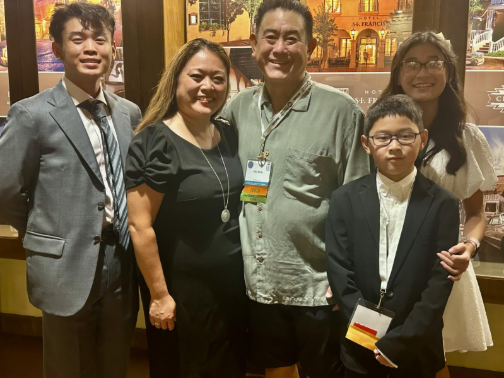
Uno Family (Pictured from left to right):
Sam (author), Sheri, Kai (Butaro’s Grandson), Jaxon and KT
Written by: Sam Uno, great grandson of Buntaro Mayeda
Want to hear about more experiences of others under the AEA? Click a name below to learn more.