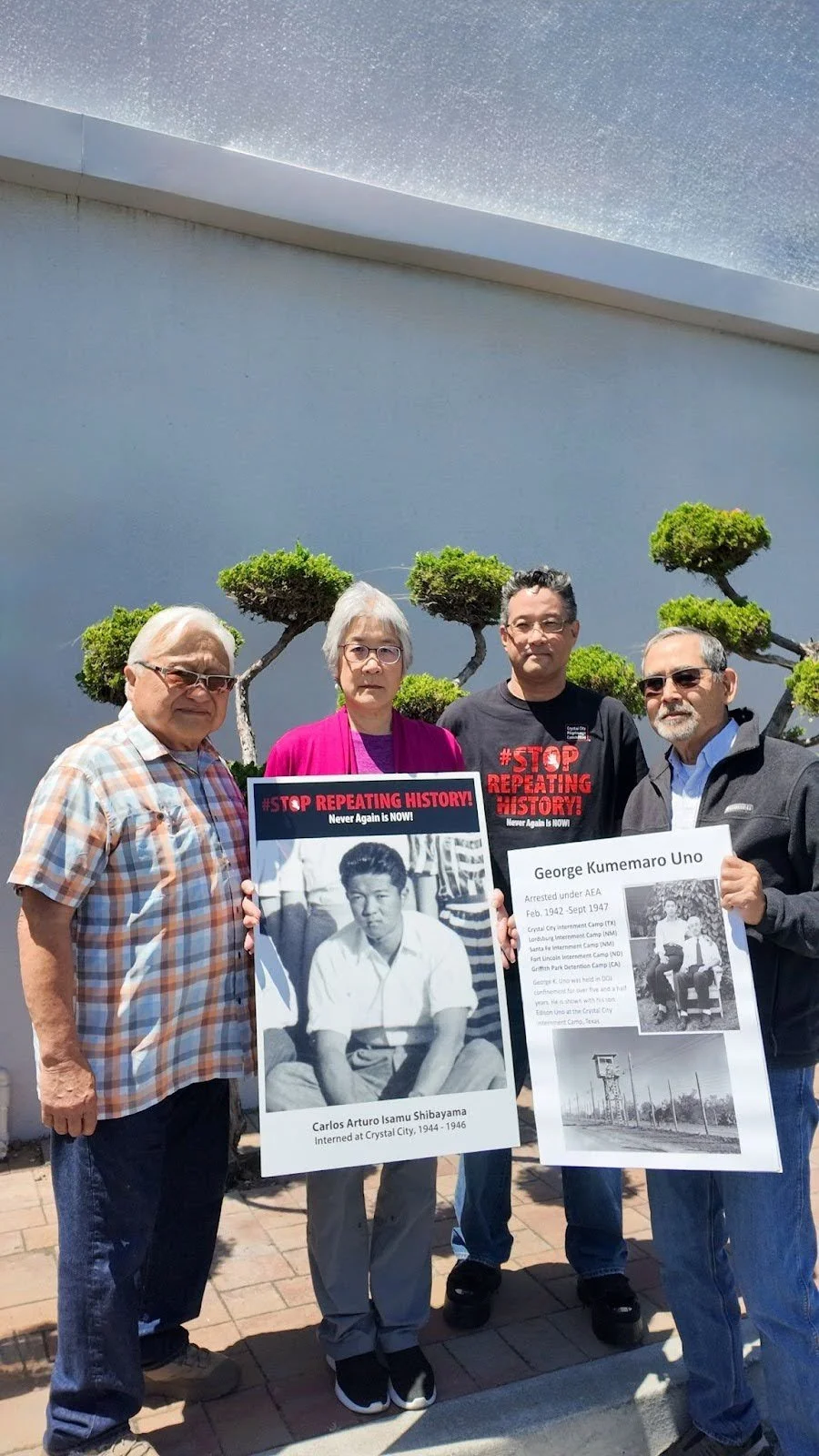
Experiences of Japanese Americans under the AEA
George Kumemaro Uno
When George Kumemaro Uno was apprehended by the Federal Bureau of Investigation (FBI) on February 20, 1942 at age 56, the government did not accuse him of espionage, sabotage, or any specific crime. Instead, the government invoked the Alien Enemies Act of 1798 and took him to the Los Angeles County Jail. This law allowed the executive branch to detain non-citizens during times of war based on suspicion.
What followed was an unusually long detention of a Japanese Issei under Department of Justice custody during World War II. George Uno remained imprisoned for more than five and a half years while most Japanese Americans were incarcerated for about 3.5 years under Executive Order 9066.
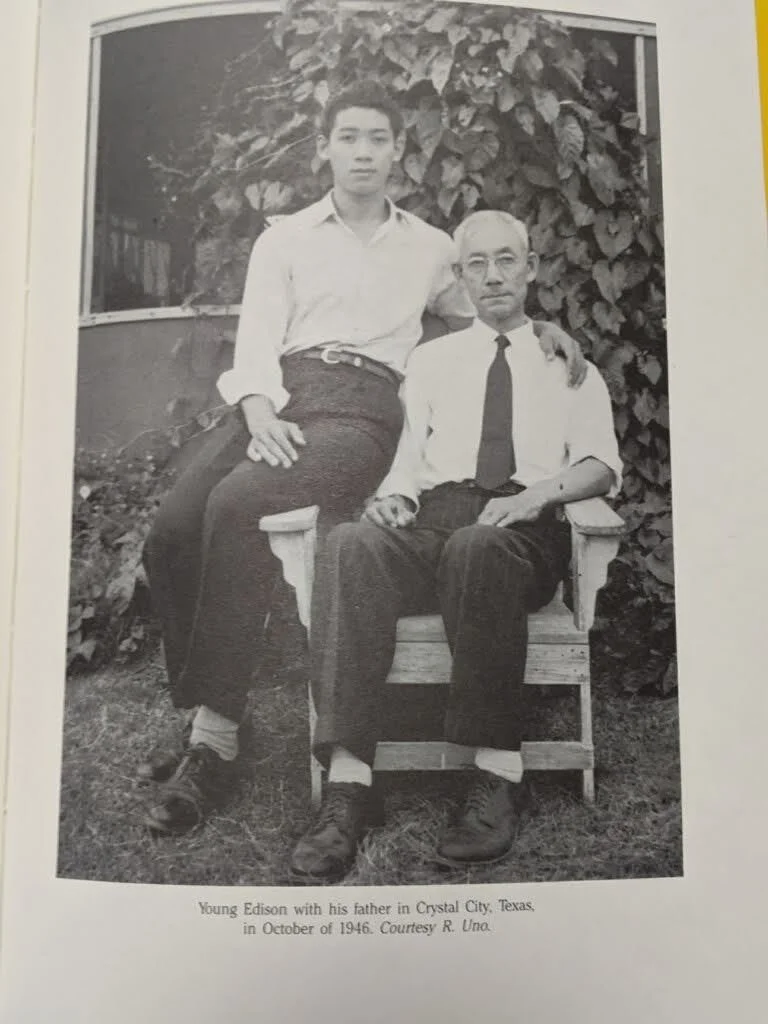
George Kumemaro (seated) with youngest son, Edison Uno, in the Crystal City Internment Camp circa 1946.
According to his grandson Victor Uno, George Uno was born into a Christian family during the Meiji period, a time when Japan was undergoing rapid westernization. George Uno immigrated to the U.S. with a formal education, fluency in both English and Japanese, and a desire to make a sustainable life with his family.
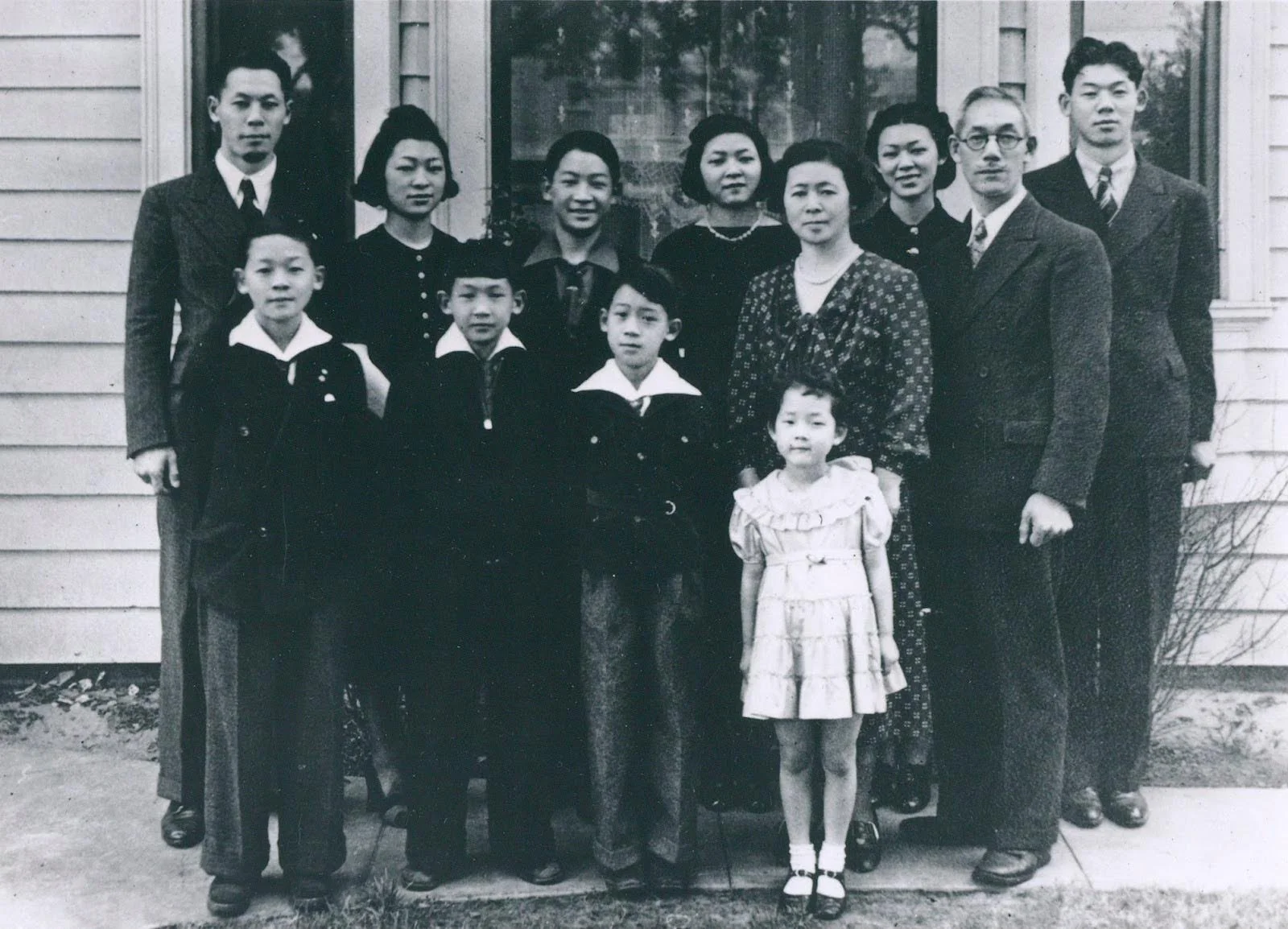
George Uno family photo taken before the war, taken in 1938 on George and Riki's Silver Anniversary.
In the U.S., George Uno lived a restless but principled life. He worked wherever opportunity appeared: on railroads in Utah, as a florist preparing arrangements for the Mormon Church, as a painter despite being color-blind, and as a self-taught entomologist selling pesticides to farmers. He also helped establish a Christian church in Salt Lake City and raised ten children with his wife, Riki Uno. Like many immigrants barred from citizenship, he invested in the community—building a life in a country that would never formally claim him as its own.
Unfortunately, none of this shielded him in 1942. After his abrupt arrest, George Uno was placed in Department of Justice custody. This was peculiar as most Japanese Americans were placed in War Relocation Authority camps; however, George Uno was put in a separate system reserved for so-called “enemy aliens.” Over the next two years, he was transferred repeatedly: from the Los Angeles County Jail to the Griffith Park detention center, then to Fort Lincoln in North Dakota, and subsequently to Santa Fe and Lordsburg, New Mexico. According to Victor, during this period, George Uno’s wife and children were incarcerated separately at Santa Anita and later at Amache, Colorado. For two years, the family was completely separated.
In March 1944, George Uno was transferred to Crystal City, Texas. This was one of the only internment camps in the U.S. designed specifically to hold families detained under the Alien Enemies Act, according to the National Immigration Law Center. There, he was finally reunited with his wife and their three youngest children: Robert, Edison, and Kay.
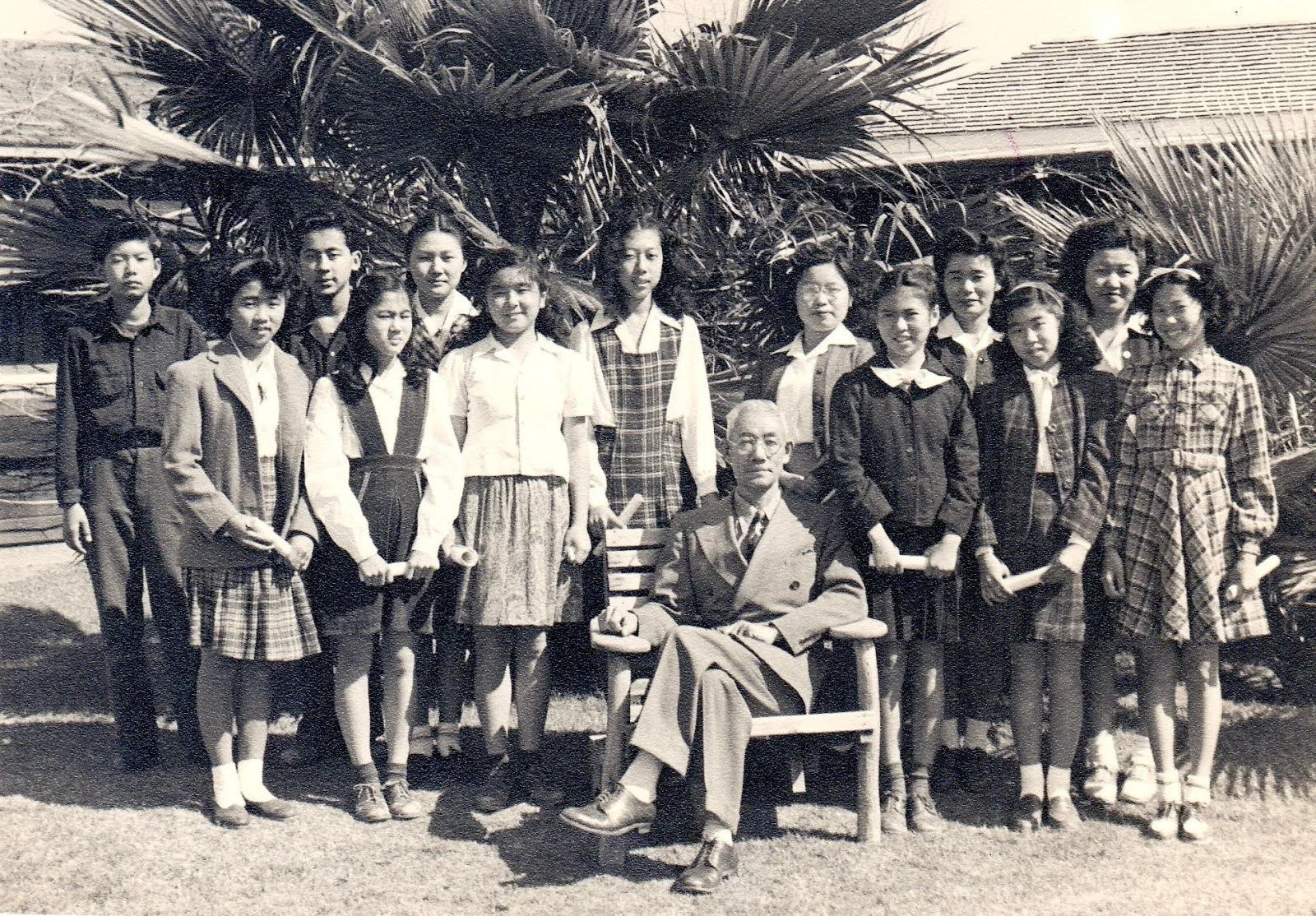
According to Victor Uno, Crystal City was also where George Uno became known as “Sensei Uno,” teaching English to Peruvian Japanese children who spoke Japanese and Spanish but little English after being forcibly brought to the United States during the war – they were very much strangers in a strange land. “Granddad also taught them American songs such as Red River Valley, a sentimental cowboy song, that they would gather and sing when an internee family would leave,” Victor shared.
Written by: Satoshi Isayama, Senior, Palo Alto High School
[1] Drawing from Crystal City Camp Story, What Happened to the Internees of War In An American Concentration Camp During WWII by Sat Ishikawa.
Want to hear about more experiences of others under the AEA? Click a name below to learn more.
Natsu Saito | Kunitomo Mayeda | Junichi & Larry Oda | Kahei Sam Morikawa | Jotaro Mori | Masuo Yasui | Heigoro Endo | Shonosuke Tanaka | Minoru Nakano | Art Shibayama | George Kumemaro Uno | Buntaro (Bob) Mayeda | Hikoshichi Higuchi | Chozo Saito
George Kumemaro Uno (seated) with Peruvian Japanese students at the Crystal City Internment Camp in Texas.
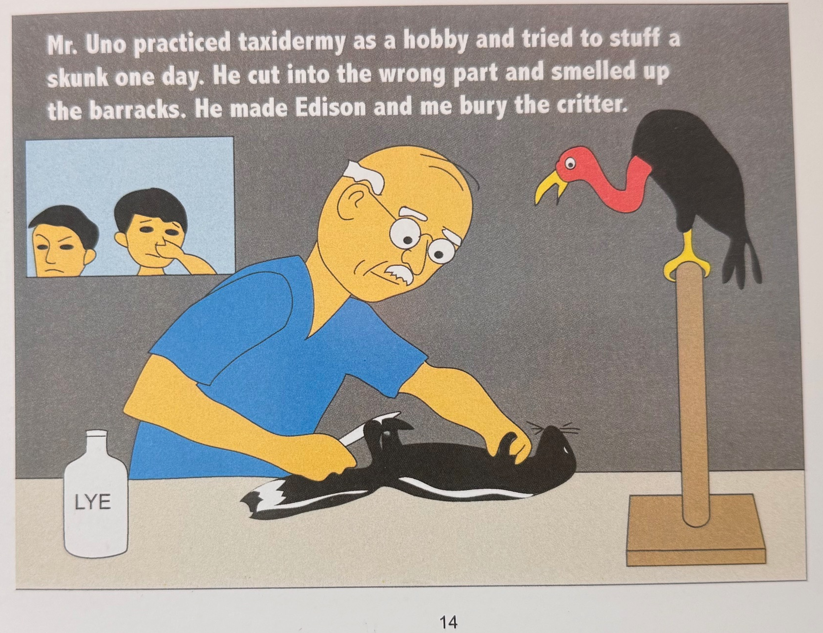
Crystal City was also where George Uno learned taxidermy from a German detainee in the camp, where George Uno was able to build on his knowledge as an entomologist. Victor tells the story that family members laughed remembering granddad's skunk mistake. Notice the mounted buzzard in the drawing? [1] He recounts that ironically “Granddad was arrested under the AEA as a ‘dangerous enemy alien,’ when he was only a danger to the local wildlife. It was funny to hear about him working on a skunk and making his son Edison and the children bury it after he made the barracks smelly.”
In August 1944, more than two years after his arrest, FBI Director J. Edgar Hoover formally informed the Justice Department that no prosecution should be pursued. A memorandum to Assistant Attorney General Tom C. Clark concluded that the facts in George Uno’s case “do not establish a violation of either the Espionage Statutes or the Registration Act.” Or, in other words, there was no crime made.
In August 1945, as the war with Japan drew to a close, George Uno applied for non-repatriation. His application made clear that all but one of his children were in the U.S., several serving in the U.S. armed forces, and that he now had no desire to be sent to Japan. A camp official reviewing the application noted bluntly that George Uno had “always been on the repatriation list” until the war’s end, as though the conclusion of the war itself were incidental.
On December 18, 1945—more than three months after Japan formally surrendered—the Repatriation Hearing Board denied his request. The government continued to classify him as “dangerous to the public peace and safety of the U.S.,” relying on alleged ideological sympathy.
In March 1946, the Justice Department issued a formal removal order directing that George Uno depart the U.S. within thirty days. The order was signed months after the war had ended, despite the FBI’s earlier determination that no crime had occurred. Through 1946 and into 1947, George Uno remained confined, even as his sons—four of them—served in the U.S military. Finally, in September 1947, more than five years after his arrest, he was released on parole into the custody of civil liberties attorney Wayne M. Collins, who had spent years fighting the unlawful detention of Japanese Americans.
In 1948, the government quietly vacated George Uno’s removal order. No apology was issued; no explanation was offered. Five and a half years had simply gone by.
The story of George Kumemaro Uno illustrates how the AEA enabled imprisonment without criminal charge, granting the government broad authority to decide who was deemed an “enemy.” Today, the individual is remembered not as an enemy or a threat, but as a teacher, caretaker, and grandfather.
George’s story was written based on original documents from the National Archives and interviews with George’s grandson, Victor Uno, who continues to volunteer for the Crystal City Pilgrimage Committee to ensure that these stories are not forgotten.
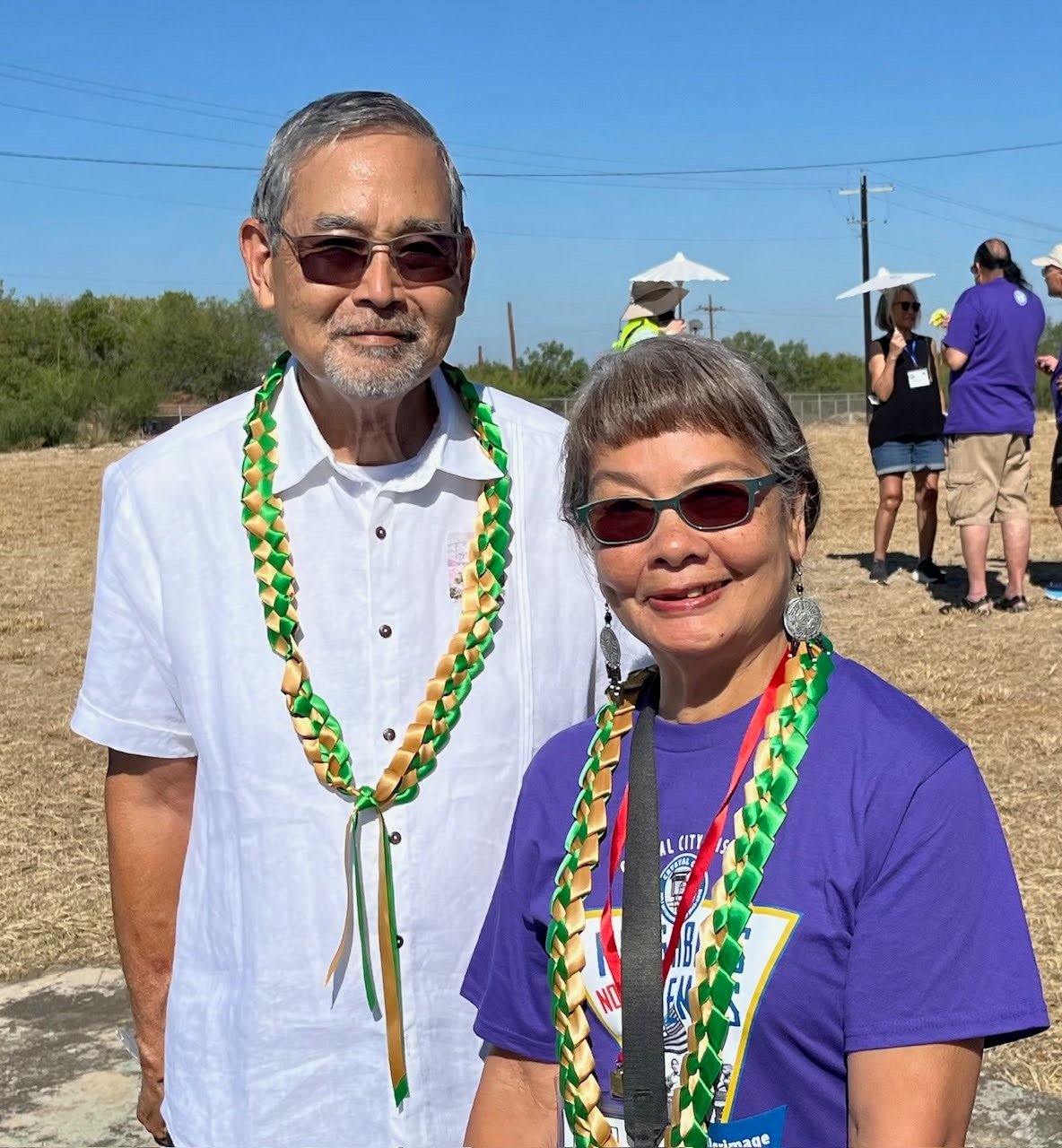
Victor Uno and his wife Josie Camacho at the Crystal City Pilgrimage 2025.
Victor Uno, at the age of 23, became an electrical worker apprentice and member of the International Brotherhood of Electrical Workers (IBEW), local 595 in Oakland. The building trades of the 1970s were still largely closed to people of color. At his first union meeting the sergeant-at-arms tore up his dues receipt and refused to let him in.
Someone in the background remarked “Are we letting Chinese in now?” But Victor was undeterred. Believing that “we need a labor movement with social justice at its core” Victor became active in the Electrical Workers Minority Caucus (EWMC) that was started by African American members to address the union’s inequalities. One of Victor’s greatest honors was to serve as President of the EWMC. As Apprenticeship Director he opened up apprenticeship programs to women and people of color so they had access to economic opportunities. In 2002, after 25 years of dedicated union activism, Victor was elected Business Manager of Local 595 - the first mainland Japanese American to hold this position. He was re-elected four more times. Twelve years later, he was appointed to be an IBEW International Representative. Victor sought to steer the union beyond “bread and butter” issues and embrace issues of social justice. When the union needed to build a new facility for their apprenticeship program Victor helped lead the creation of the Zero Net Energy Center (ZNE Center). The ZNE is not only an opportunity for apprentices to gain cutting-edge sustainable technology careers, but contributes to addressing climate change. It has reduced energy use by 75% compared to similar sized commercial buildings. In retirement Victor organizes for the Crystal City Pilgrimage Committee that advocates for justice for survivors and descendants of the WWII Crystal City Family Internment Camp.
Victor lives in Oakland with his wife, Josie Camacho. They raised two sons, Nacho and Amado, and have two grandchildren, Kaia Kiku and Leo Nacho.