
Experiences of Japanese Americans under the AEA
Shonosuke Tanaka — Owner of City Cafe in Juneau, Alaska
On December 8, 1941, the day after Japan attacked Pearl Harbor, the FBI came and searched our home. I was just nine years old at the time. We were in the house, and we were so fearful. They did not find anything incriminating. Yet, after the search, they arrested my father, Shonosuke Tanaka, a non-citizen of the U.S., a ”lawfully admitted for permanent residence” to the U.S. on June 16, 1923, without a warrant or due process, and jailed him in the federal jail in our town of Juneau, Alaska, for a short period. We were all devastated. The paperwork I found in his Alien Enemy File, many years later, has a blank on the line for “Presidential Warrant issued.” As a young child, I, along with my two high school-age brothers, John and William, my toddler sister, Mary, and my mother, Nobu, watched helplessly as the FBI took my father away.
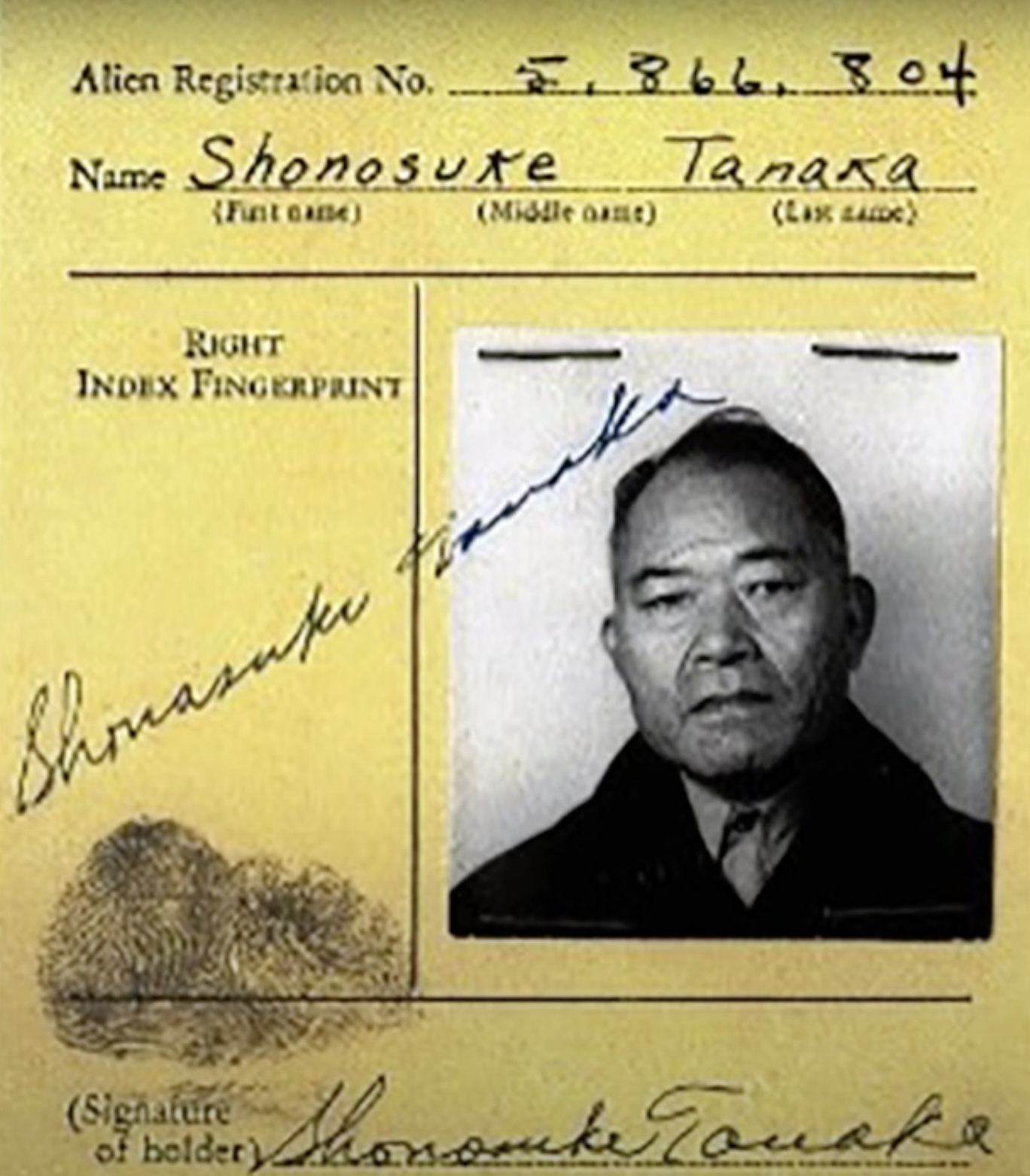
Today, I assume he was arrested under the Alien Enemies Act since he was a Japanese national who had applied for citizenship, but like all Issei, he was “ineligible.” The few other Japanese men in our town were also arrested. None had committed any crimes. My father owned and operated the City Cafe, a local neighborhood restaurant that had to close due to his arrest along with his Japanese employees. Our family no longer had a source of income. According to the government records, they assessed his lost assets (not including “intangible” property assets) at $25,300, or by today’s value, $552,587.38. That same document calculates the total property assets that were left behind by all Japanese Americans who were incarcerated from the Territory of Alaska at $917,400.00, which would be valued at $20,037,299.08 today. I also have a copy of his War Relocation Authority file in which I found a note from a government worker, “Chapman,” who interviewed my mother, Nobu. Chapman stated, “Mrs. Tanaka says that their lawyer in Alaska says that all their things in storage were burned up.” My father was later shipped to Anchorage, Alaska, and imprisoned for a short period at Fort Richardson. Communication with him was very minimal until he was imprisoned at a Department of Justice Internment camp at Lordsburg, New Mexico, and finally at an all-men Department of Justice camp located in Santa Fe, New Mexico, where his letters were censored.
In April 1942, the remainder of our family, along with some 200 other Alaskan Territory Japanese American and Tlingit families, now devoid of their "head of household", were shipped to a hastily constructed "Assembly Center" in Puyallup, Washington. The FBI report made on July 1, 1942, stated after an interview with my mother, Nobu: “There are no outstanding leads and the investigation has not indicated that the subject was engaged in espionage activities.” Of course, we did not have access to any of these reports at the time, so we did not know their conclusions. My mother, my siblings, and I were sent to Minidoka "Relocation" Camp, located in a desolate land in Southern Idaho.
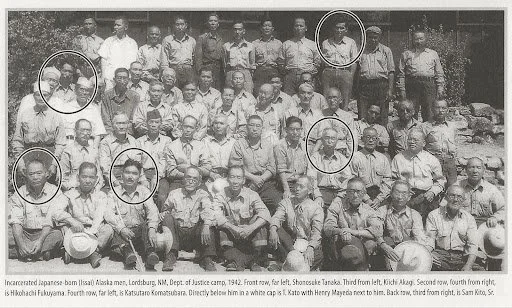
(From Quiet Defiance: Alaska’s Empty Chair Story, p.33 by Karleen Grummett)
Our family wrote letters to the Justice Department asking for the transfer of my father from the Santa Fe camp to Minidoka. In my ten-year-old script, I wrote a letter on August 24, 1943, to Mr. Edward Ennis, director of the Department of Justice Alien Enemy Control Unit:
My brother received your letter of August 16, 1943. We were all very sad & disappointed to know that my father, Shonosuke Tanaka, could not be paroled. My brothers & sister feel very badly because our friends' fathers will be coming to join their families, but we will not be able to see our father. My mother is also very worried and sick.
I would like you to try again to see if my father can be paroled. If there is any think [sic] I or my brothers can do to help my father join us, please let me know.
My mother wrote a letter dated December 27, 1943, which is difficult for me to read now:
…when all Alaska people of Santa Fe Detention Station came home here, only my husband could not be found among them. My children cries over “why my father do not come home?” I can not find word to explain this terrible matter to my small children.
My mother asked many upstanding members of the Juneau community to also write letters on the goodness of his character, and they did.
Apparently there was a hearing. There is an undated “Synopsis of hearing record” in my father’s War Relocation Authority file that states he entered the U.S. in 1900 (approximately) and was denied citizenship in 1904. According to the synopsis, “The hearing record discloses that he is well regarded by the people of Juneau.” Apparently, he was detained because he corresponded with the Japanese Consulate in Seattle, and he was asked to form a Japanese association in Alaska. In 1939, he collected money for the families of Japanese soldiers. However, on December 10, 1943, the order for his parole to “a War Relocation Authority Project” by B.M. Bryan, Brigadier General, Assistant Provost Marshall General, was approved, and he was reunited with us at Minidoka incarceration camp.
In March of 1944, over two years after that frightful night when we were separated, he was finally released for “parole” to Minidoka incarceration camp. We had not seen him since December 1941, so you can imagine the emotion of our reunion with him. The war ended in August of 1945. We returned to Juneau, Alaska, when we were finally allowed to leave Minidoka on October 20, 1945. We returned without my two older brothers. John was serving with the 442nd Infantry Unit in Europe. Bill (William), who finished high school in Minidoka, had left for Chicago. My father, now sixty-five years of age, took out a loan from the bank and reopened his cafe. He was remarkably resilient. He died in Juneau, Alaska, at age 75 in 1957.
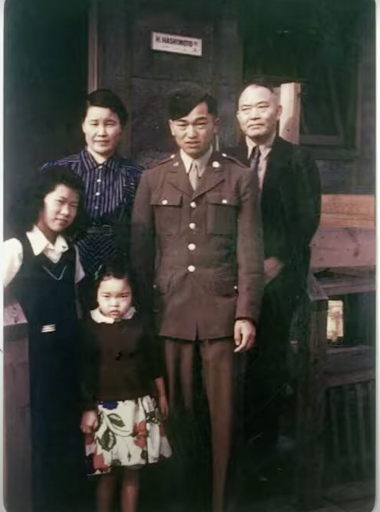
Left to right: Alice, Nobu, John, Shonosuke, and Mary (front in dress) Tanaka at Minidoka WRA camp circa 1944
Written By Alice Chiyoko (Tanaka) Hikido
Sources:
“In the Same Boat” I am California of the Past, Digital Story Station accessed April 3, 2025
https://www.youtube.com/watch?v=c91_F56A4ZQ
Shonosuke Tanaka’s Alien Enemy File Index card
https://drive.google.com/file/d/1mUUHbMmJKKVc3jZ3hernE4jpOOq2pHhv/view?usp=drive_link
Shonosuke Tanaka’s Alien Enemy File
https://drive.google.com/file/d/1aq-BVO4hS33O5nLNhZvFHle8u5G50qOm/view?usp=drive_link
FBI Report July 7, 1942 https://drive.google.com/file/d/1c3QP4j-8t4d3qgZ0-KftqKjgxaUtLY0G/view?usp=drive_link
War Relocation Authority, Office of the Solicitor, Phillip Glick, Washington, DC
https://drive.google.com/file/d/1sVCInpgdy3gEmWRMzbPcxWsTuN7wHLPp/view?usp=drive_link
Other resources on the Tanaka Family
Alice Hikido - 2021 San Jose Day of Remembrance
https://www.youtube.com/watch?v=gXXaYlrIaQc
KPIX CBS News Bay Area
https://www.youtube.com/watch?v=wi3Fwqnfh10
Gastineau Channel Memories
https://juneau.org/library/museum/gastineau-channel-memories-browse/entry/17461
Empty Chair Project website
https://emptychairproject.wordpress.com/
Empty Chair book by Karleen Grummett
https://www.amazon.com/Quiet-Defiance-Alaskas-Empty-Chair/dp/0967918219
Empty Chair film by Greg Chaney
Want to hear about more experiences of others under the AEA? Click a name below to learn more.