Experiences of Japanese Americans under the AEA
Jotaro Mori
On Sunday, December 7, 1941, Jotaro Mori went fishing. For Mori and the other Japanese men, fishing was survival — a way to nourish the impoverished Japanese community.
When he returned home, tired, the FBI was waiting. With no notice, without providing a reason, they took him — 59 years old — to the Tacoma City jail. His family did not know where he was. He was not allowed to call them or have access to an attorney. He had been living in America legally for 41 years, owned a successful laundry business, and raised 3 American-born daughters. He was incarcerated for over 4 years and finally released at the end of 1945. Three months after the war with Japan had ended.
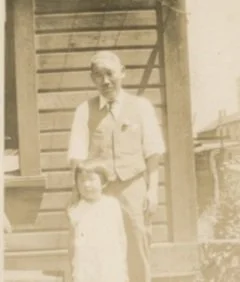
Jotaro Mori after WWII
“Incarceration turned him into an old man”
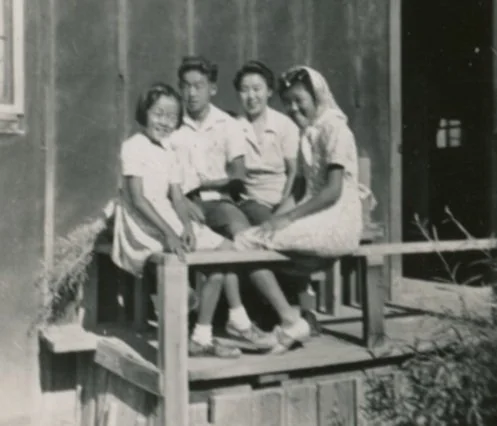
Jotaro Mori’s grandchildren, Kay, Masatoshi (my grandfather), Fusae (97 years old), and Keiko Fujii, outside their barracks at Heart Mountain Incarceration Camp, 1945.
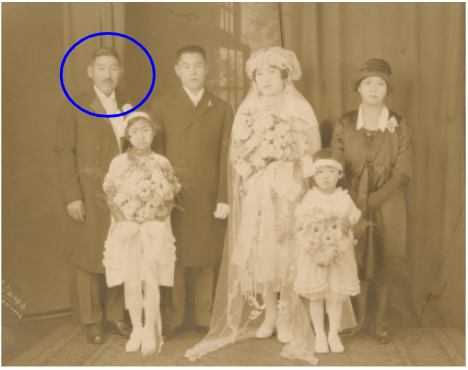
Jotaro Mori, Takeo Fujii and Kiku Mori Fujii, Kinu Mori, and flower girls Ayako and Yasuko Mori. My great-grandparents wedding photo, circa 1925
For three weeks, Mori was held in the jail at Tacoma City Hall, and his family finally learned that he had been sent to Ft. Missoula, Montana along with “enemy aliens” from Japan, Italy and Germany. After Missoula he was sent to Department of Justice/INS camps in Santa Fe and Lordsburg, New Mexico. After a year had passed, the family learned that they could request a rehearing where they could submit letters of support from community members attesting to Jotaro’s loyalty and character. The local bank and a laundry trade association wrote letters attesting to his fine moral character and good citizenship. Finally, in mid 1943, he was paroled from Lordsburg, one of the harshest facilities, to the War Relocation Authority (WRA) camp in Tule Lake to reunite with the rest of his family who had been taken there from Washington State. Because their family responded “Yes, Yes” to the loyalty questionnaire, after about a year, they were moved out of Tule Lake to the WRA camp in Jerome, Arkansas. When Jerome was closed down they were sent to the WRA camp in Hearth Mountain, Wyoming.
Mori had come to the United States 41 years prior in 1900, a young man looking for a better life. Before the war, Mori had been a respected member of Tacoma’s Japanese community. A sewanin—a caretaker—he devoted himself to the community through the Tacoma Buddhist Church and the Japanese Language School. He was not a leader, not political. Tragically, other community leaders who were detained alongside him did not survive. The principal of Tacoma’s Japanese School, arrested around the same time as Mori, died in custody.
By the time he reunited with his family in 1943, Jotaro had aged dramatically. "When he came back to Tule Lake, he got off the bus, and he was an old man." His granddaughter, Fusae Yoshida, recalled. “To this day, I cry when I think about it."
Fusae heard from Italian detainees at Fort Missoula that they had sham hearings with civilian review board members. He was not allowed an attorney, could not choose his translator, and had no opportunity to challenge allegations made against him. On January 30, 1942, the review Board in Missoula unanimously recommended parole without bond, but the U.S. The Attorney General recommended internment. The government files include made-up charges against him that were contradicted by his responses to questions that he was asked at the proceeding, which were documented.
After the war, Jotaro, then an old man, and his wife, Kinu, found shelter with their eldest daughter on Vashon Island. He was too old to restart his business. Japanese were not allowed to own land, so they had no home to return to. His wife, Kinu, her body failing after a stroke suffered at age 60, spent her final days in a shabby care home for the indigent.
It was not until 1952, with the passage of the McCarran-Walter Act, that Mori and Kinu finally became U.S. citizens. Their daughter Kiku fought her own battle. Though born in Napa, California, she had lost her citizenship by marrying an "alien," Takeo Fujii. Years later, she would stand in a courtroom, her daughter Fusae by her side, trying to reclaim the birthright citizenship that had been stripped from her without apology.
Written by: Naoko Fujii, great-granddaughter of Jotaro Mori
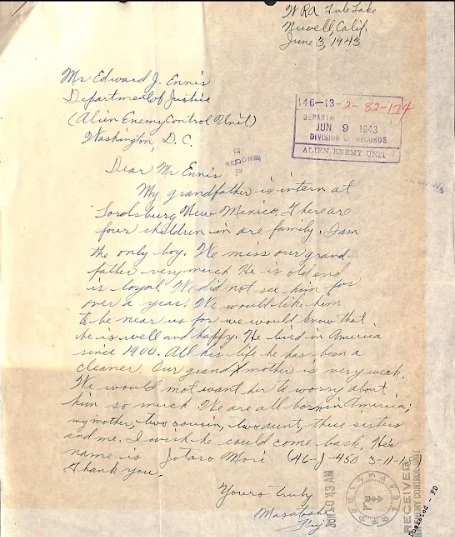
The DOJ file contains heartfelt letters from his grandchildren pleading for the release of their grandfather, Jotaro, from the Lordsburg detention facility. This one was written by my father, Masatoshi Fujii, dated June 3, 1943.
Want to hear about more experiences of others under the AEA? Click a name below to learn more.