JACL Commemorates the Legacy of Japanese American Redress
October 9, 2026
For Immediate Release
Media Contact:
Carol Kawase, VP of Public Affairs, ckawase@jacl.org
Matthew Weisbly, JACL National Education Programs Manager - LA Office, mweisbly@jacl.org
On this date, October 9, 1990, Attorney General Dick Thornburgh presented the first redress checks to nine survivors of Japanese American wartime incarceration in a special ceremony held in Washington D.C. This historic moment marked a major milestone and turning point in the decades-long fight for an apology and justice led by Japanese American survivors, their children, and community allies. The Civil Liberties Act of 1988 and the broader redress movement demonstrated the true power of solidarity and coalition building, ultimately proving that a formal apology and reparations from the federal government are possible.
Today, the legacy of redress and lessons learned continue to shape and inspire our work. We are committed to advocating for modern-day redress and a formal apology for Japanese Latin Americans interned and incarcerated during World War II and reparations efforts for the Black community, including participating in a national movement supporting the passage of H.R. 40/S. 40, the Commission to Study and Develop Reparation Proposals for African Americans Act, and final passage of the commission’s recommended reparatory policy.
To mark this anniversary, we asked Peggy Nagae, Martha Watanabe, and Kathy Masaoka, three extraordinary leaders who fought for redress in their own trailblazing ways, to reflect on what this day means to them and what the legacy of redress means for the work ahead.
“I was honored to serve on the JACL National Redress Committee, where we drafted proposed congressional legislation for redress—including a formal apology, individual compensation, and $25,000 per survivor for their forced incarceration during WWII. I was proud when our resolution was adopted at the 1978 JACL Convention in Salt Lake City and ultimately signed into law by President Reagan in 1988. Yet, the most moving moment for me was the picture of U.S. Attorney General Dick Thornburgh presenting the first redress checks to the Issei survivors at the Department of Justice ceremony.
Additionally, I was honored to serve as a presidential appointee under President Clinton to the Civil Liberties Public Education Fund Board, where we awarded $3.5 million in grants to organizations working to ensure the injustices faced by Japanese Americans are never repeated. I also had the privilege of serving as lead attorney for Minoru Yasui, successfully reopening his WWII Supreme Court case and securing the vacation of his original conviction.
Repairing these wrongs to heal our Japanese American community is vital not just for us, but for all Americans. It reinforces the truth in Dr. Martin Luther King, Jr.’s words: 'Injustice anywhere is a threat to justice everywhere. We are caught in an inescapable network of mutuality, tied in a single garment of destiny. Whatever affects one directly, affects all indirectly.”
My work advocating for redress and repair within the Japanese American community ultimately led me to my work today as one of Tsuru for Solidarity’s co-chairs of the Black Reparations and Solidarity campaign. The systemic injustices Black Americans have endured over generations are vast, and securing their redress and repair will be of great benefit for us all. We cannot be healed as a nation until this defining injustice is addressed.”
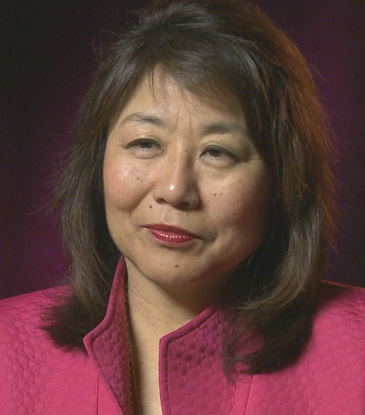
Peggy Nagae, JACL’s National Redress Committee
Photo Courtesy of Densho Digital Repository
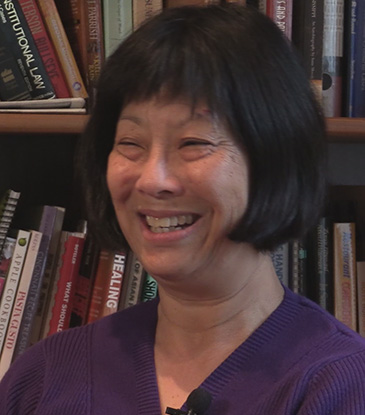
Martha Watanabe, Former Staff at the Department of Justice's Office of Redress Administration (ORA)
Photo Courtesy of Densho Digital Repository
“Watching Attorney General Richard Thornburgh kneeling as he spoke to each recipient as he presented the letter of apology and check is something I will never forget. It wasn't till afterwards that I realized how fortunate I was to have been a part of the staff at ORA as a Japanese American and to work with and for the community and be a part of our history.
Bob Bratt, as the first Administrator of ORA, deserves so much credit. He undertook his mission, believed in his mission and conveyed that to the staff. Most of the staff was not Japanese American but they all came to embrace the office mission, believe in the mission and were eager to learn more about the Japanese American incarceration experience.”
“We Sansei were motivated by the Issei to fight for redress, and we knew that, win or lose, it would take a grassroots movement in the Japanese American community. And we did win - with support from other communities who understood that this was a shared fight. It taught us that reparations for Black Americans is possible, owed, and long overdue.”
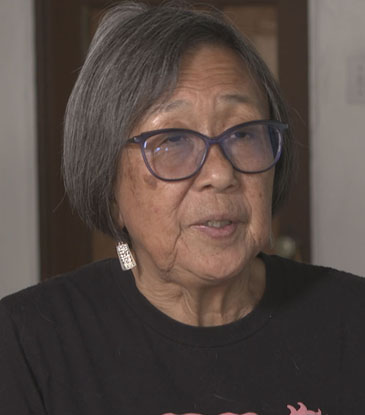
Kathy Masaoka, Nikkei Progressives CC/ NCRR co-chair
Photo Courtesy of Densho Digital Repository
###
The Japanese American Citizens League is a national organization whose ongoing mission is to secure and maintain the civil rights of Japanese Americans and all others who are victimized by injustice and bigotry. The leaders and members of the JACL also work to promote cultural, educational, and social values and preserve the heritage and legacy of the Japanese American community.